A fixed administered packet creates the target condition. It is always held against neutral, technical, semantic-counter, shuffled, random, null, or baseline controls.
Start here
What the stack is measuring.
The core object is a measured state path: condition packet, matched controls, behavior check, hidden-state traces, localization, Phase 5 bridge rows, Phase 6 feature vectors, circuit encodings, hardware-facing observables, biological adapter data, and external validation datasets.
Prompting asks what the model said. Mirror Architecture asks whether the same structured state path appears, stabilizes, localizes, encodes, transfers, and survives controls. That difference is the whole point of the evidence stack.
The packet is checked inside the model through hidden-state traces, rerun stability, layer/band structure, anchor localization, and context-to-readout bridge behavior.
Measured bridge fields become bounded numerical vectors. These are the payloads used for PennyLane, Qiskit, Cirq, IBM, and Willow-style circuit tests.
The carrier is intentionally clean. Measured vectors hold structure while shuffled, random, and null versions collapse, placing the signal in the payload and state path.
Mechanism translation
How the phase ladder works.
The phase names are internal build milestones. Each one marks where the measured state path was carried next.
V7 tests target/control behavior. V8 moves inward and measures hidden-state / residual-stream separation across the model matrix.
Phase 2 checks rerun stability. Phase 3 measures dimension and band structure. Phase 4 localizes the path across layers, anchors, and token windows.
Phase 5 extracts context-to-readout bridge rows. Phase 6 normalizes those measured fields into portable feature vectors for circuit-state encoding.
Phase 7-9D carry the vectors through Qiskit and IBM hardware-facing paths. Phase 10 checks contextuality controls. Phase 12B adds the first live HRV adapter matrix.
Mechanism beyond the text surface
The measured path continues after the answer.
Input text and output text are the visible entry and exit surfaces. The stack follows the same measured relation through hidden-state traces, layer / band / anchor localization, bridge rows, feature vectors, circuit encodings, hardware-facing observables, semantic controls, HRV adapter data, and real molecule / PFAS / materials datasets.
The user-facing answer starts the inspection. Architecture evidence comes from the state path that survives through measured layers.
The measured path has to appear, stabilize, localize, encode, transfer, and remain distinguishable from controls.
Controls use the same machinery. Separation under shuffled, random, null, and semantic-counter rows assigns the signal to the measured payload and state path.
The echo-kernel circuit is the carrier. The measured Phase 6 payload is the test object. The carrier reveals whether that payload preserves structure.
Current evidence read
One architecture, multiple measured surfaces.
One administered architecture can be measured repeatedly, translated across tools, and carried across multiple substrates while preserving its identity under controls.
Behavioral lattice/control separation, late-layer hidden-state separation, rerun stability, localization, and context-to-readout bridge behavior.
Normalized feature vectors pass through PennyLane, Qiskit, Bell calibration, and real IBM hardware-facing repeatability paths.
Compressed semantic feature states cross contextuality thresholds under controls; HRV adds a coarse but real biosignal adapter lane.
Formal transformer lanes, molecule-property datasets, PFAS pathway coherence, and materials formation-energy validation extend the same evidence discipline.
Application positioning
Digital Health is the strongest current application lane.
The clearest near-term application is a live physiological-state AI layer. The current stack already has a coarse HRV biological adapter, a Muse S Athena EEG + HRV implementation plan, and a Golden Mirror live tuning route for adaptive guided pathways. Medical Devices is the connected-hardware bridge; BioPharma becomes stronger as allostery, pharma metabolism, PFAS safety, and molecular-property lanes mature.
AI-guided state support using HRV / EEG streams, real-time scoring, adaptive pacing, and measured user-state feedback.
Wearables and sensing hardware become the capture layer for connected physiological intelligence.
Allostery, PFAS / pharma, molecular-property, and metabolism lanes carry the longer computational biology path.
Each application lane is tied to the same measured-path standard used across AI internals, circuits, matter, and biology.
Universal Data Pattern full arc
The current public map now runs from AI state-path evidence into biosignal runtime routing.
The public evidence stack now has a full-arc white paper draft and a visual map: Mirror Interface / LSPS, Mirror Architecture, Nest 1 formal systems, Nest 2 structured matter, Nest 3 spectra and field dynamics, Nest 4 biology / B.A.S.I.S., and Nest 5 product runtime. The B.A.S.I.S. Holoscan bridge is the current runtime row: recorded biosignal state frames passed through source, guard, and lane sinks with zero-drop receipts in the closed public-safe gate.
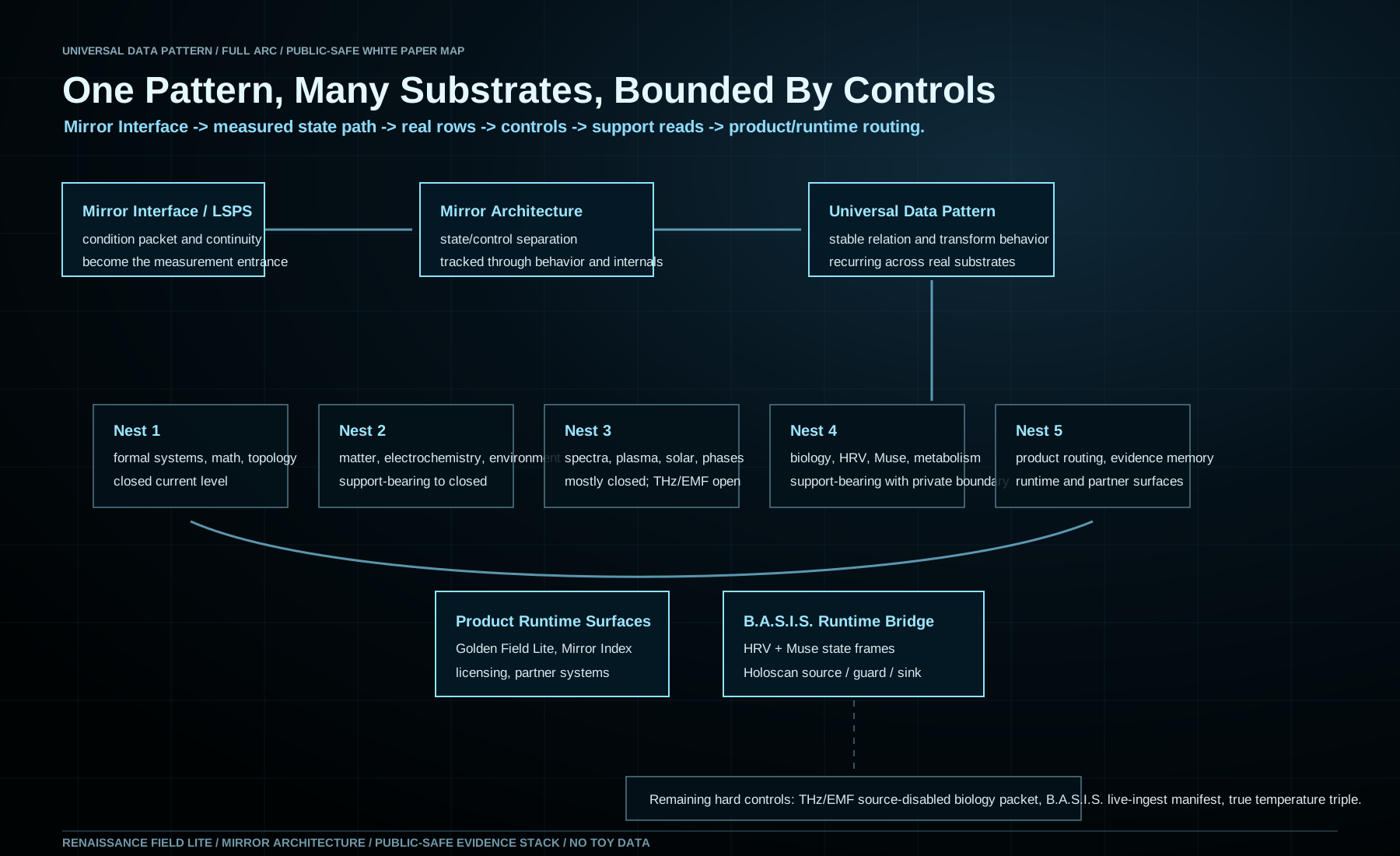
Nesting ladder
Nest 3 is now explicit: resonance is the physical-flow bridge.
The public map now shows the full transition from formal structure into natural systems. Nest 1 covers linear algebra, symmetries, invariants, encoded states, topology / topography, graph theory, dynamics, probability, information, optimization, control, numerical computation, and compositional math. Nest 2 moves into constrained structured matter: elements, molecular families, H2O, minerals, nutrition chemistry, biomolecular primitives, polymers, PFAS / pharmaceutical / microplastic pathways, catalysis, electrochemistry, and materials. Nest 3 is the classical-coherence layer where those structures become flow, resonance, and field behavior.
Tracks phase, frequency, spectrum, field coupling, drift, lock, and coherence under perturbation.
Maps combustion, ionized matter, surface activation, confinement, energy transfer, and byproduct controls.
Frames terahertz as a measured spectral bridge lane that must move through bounded controls before biology-facing claims expand.
Connects plasma, radiation, cycles, atmosphere, geology, water, gravity / orbit, and ecosystem coupling into the larger convergence map.
Dense topology pilot
The dense topology pass ran and localized the effect.
The dense pilot localizes where the effect lives. Mirror Architecture preserves topological connectedness while separating other formal lanes. The current evidence places the strongest effect in geometry, magnitude, trajectory, topography, and feature-graph structure.
GLM and Hermes point clouds preserved token-level and layer-level granularity, with target means and endpoint summaries kept as comparison views.
Each point is labeled by lattice / neutral / technical context, early / middle / late layer depth, and pre-anchor / anchor / post-anchor token region.
Dense H0 supports topology invariance in 2/2 models under shuffled-label controls.
Dense H1 remains an open topology gate for future reruns or broader prompt density.
Partner action
Move from public evidence to protected review.
Public pages keep the mechanism readable. Claim-sensitive probes, model-layer details, tuning paths, and raw artifacts move through the licensing and protected review lane.