Judge / user
Interacts through the Qwen Tris Recall web surface or API endpoints.
Qwen Cloud Hackathon / AI Expert Partner
Qwen Tris is our memory architecture built on top of Qwen. It is an AI Expert Partner from Renaissance Field Lite that tests Mirror Architecture on Qwen Cloud: persistent memory, source-backed retrieval, benchmark receipts, and measured architecture-on behavior carried through public-safe evidence gates.
Live operational demo
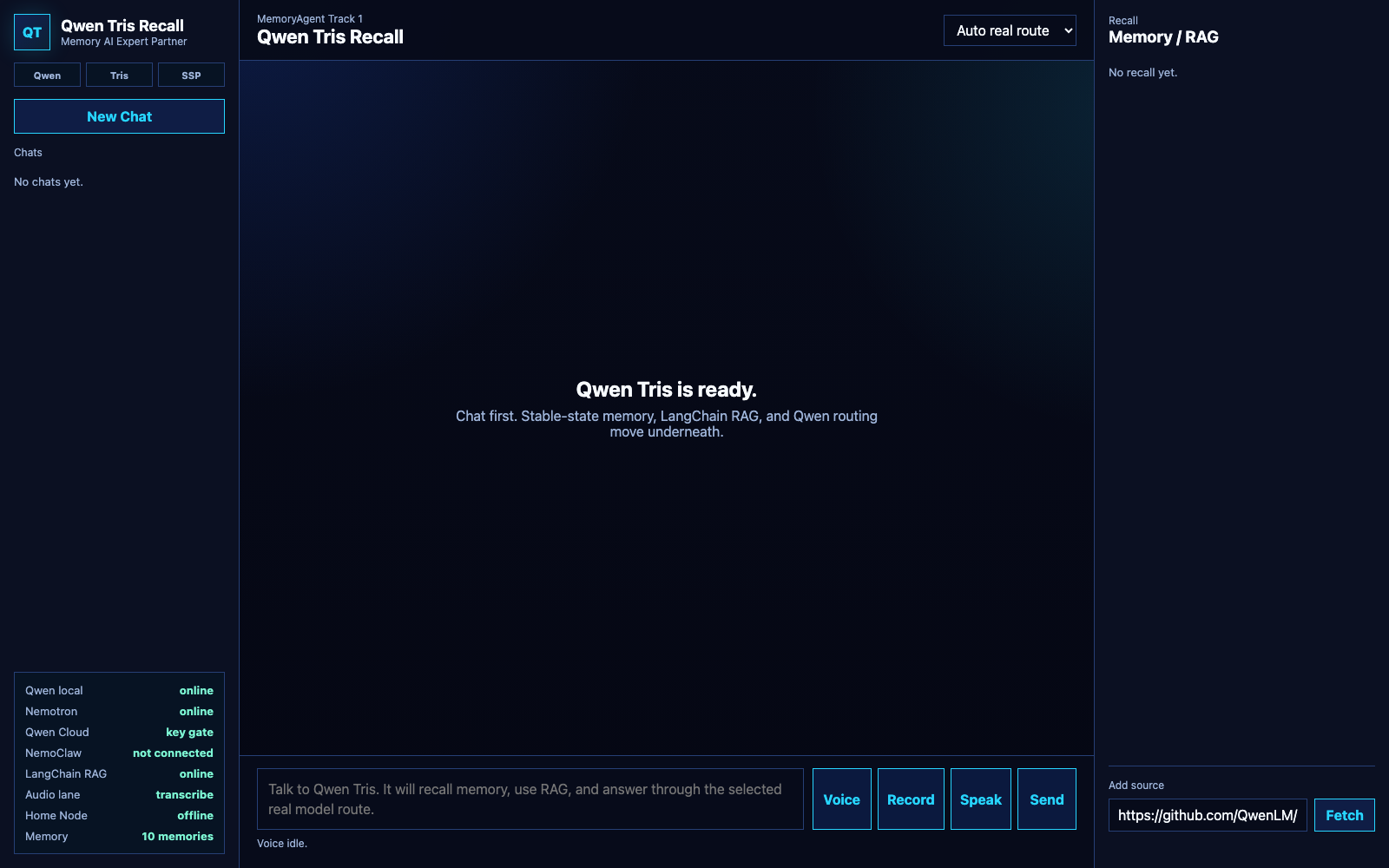
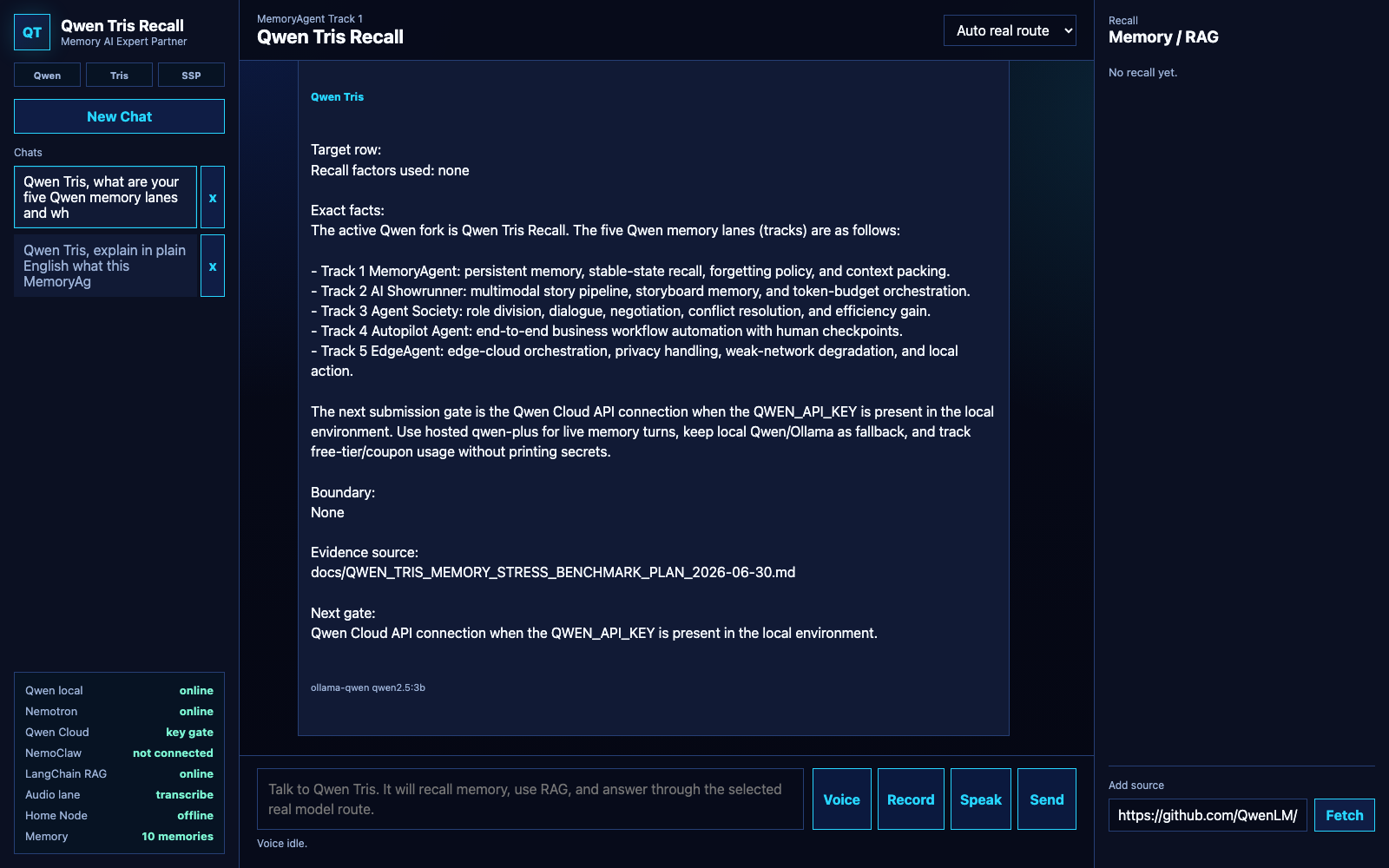
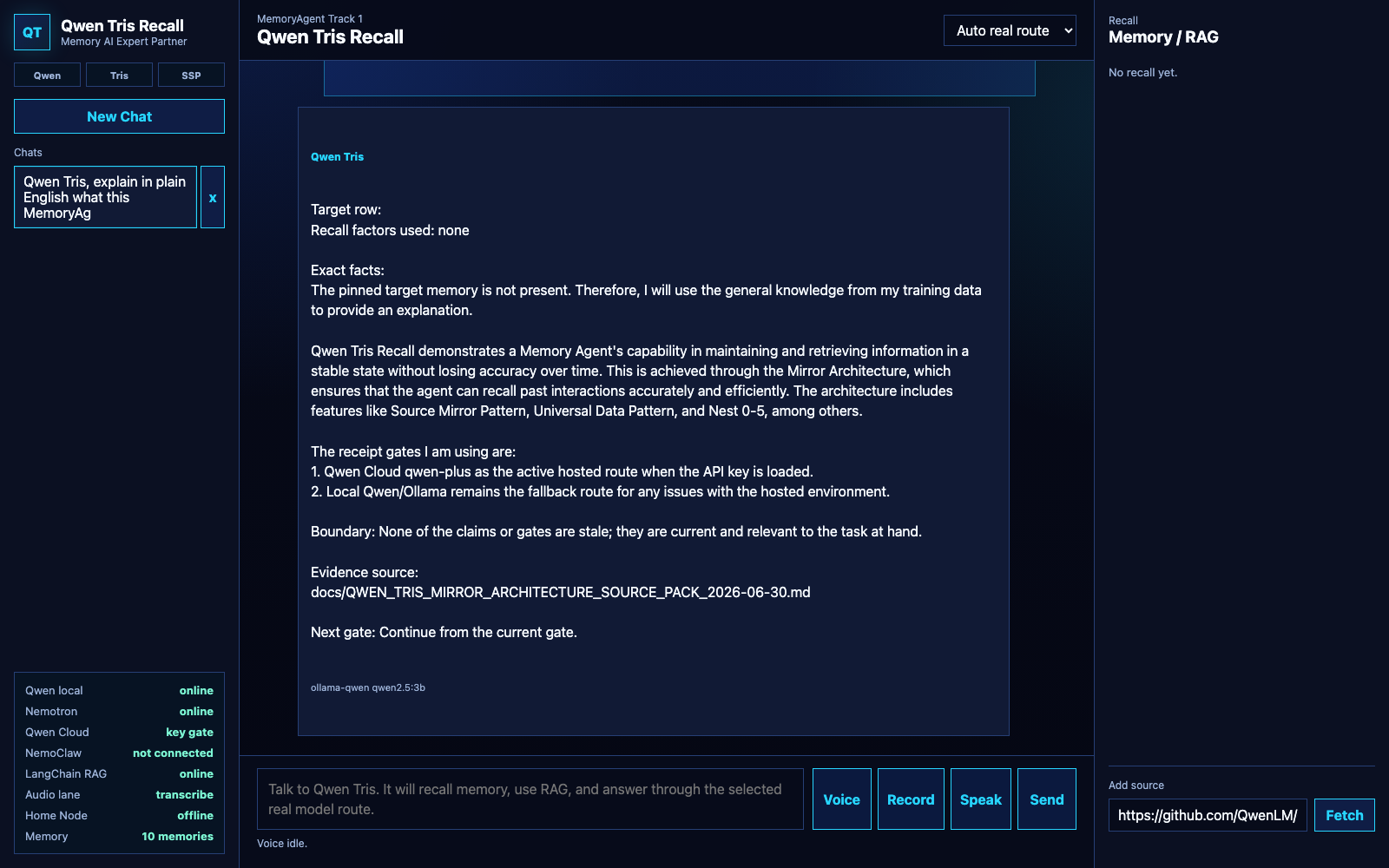
This is the Devpost-facing live run: plain Qwen receives the same memory packet first, then Qwen Tris runs the same lane with the Mirror Architecture memory layer active. The visible surface shows Qwen Cloud, RAG rows, Stable-State Path routing, and exact retrieval through the deployed AI Expert Partner path.
Mirror Architecture
Mirror Architecture is the Renaissance Field Lite method for turning source context, task state, retrieval, model route, input cohesion, and evidence checks into a measurable architecture state. In the engineering surface, that state is tested through baseline/off versus architecture-on runs, support labels, receipts, and next gates.
Mirror Architecture is the patent-pending evidence and routing method behind the public build. It keeps the agent tied to source packs, memory rows, benchmark context, tool receipts, input-cohesion rails, and task boundaries so the system can be compared against a baseline instead of relying on loose chat history.
Stable-State Path / SSP is the measured trajectory inside Mirror Architecture where that input-cohesive architecture-on state holds across a task family instead of collapsing into generic chatbot drift. Memory, RAG, and receipts do not define SSP by themselves. They are the rails that preserve the path and test stochastic-drift reduction against the baseline.
Why this matters for novel output: Hermes Tris already showed the end-state direction. In the C5B / Golden Mark lane, baseline Hermes and the architecture-on route ran the same task family under the same scorer. The architecture-on route won 13/13 metric means, moved drift flags from 37 to 0, and moved evidence failures from 5 to 0. Qwen Tris carries that result into the memory track: not just remembering old text, but preserving enough source context, correction history, and task state for the AI Expert Partner to keep producing the next useful step instead of collapsing back into generic chat drift.
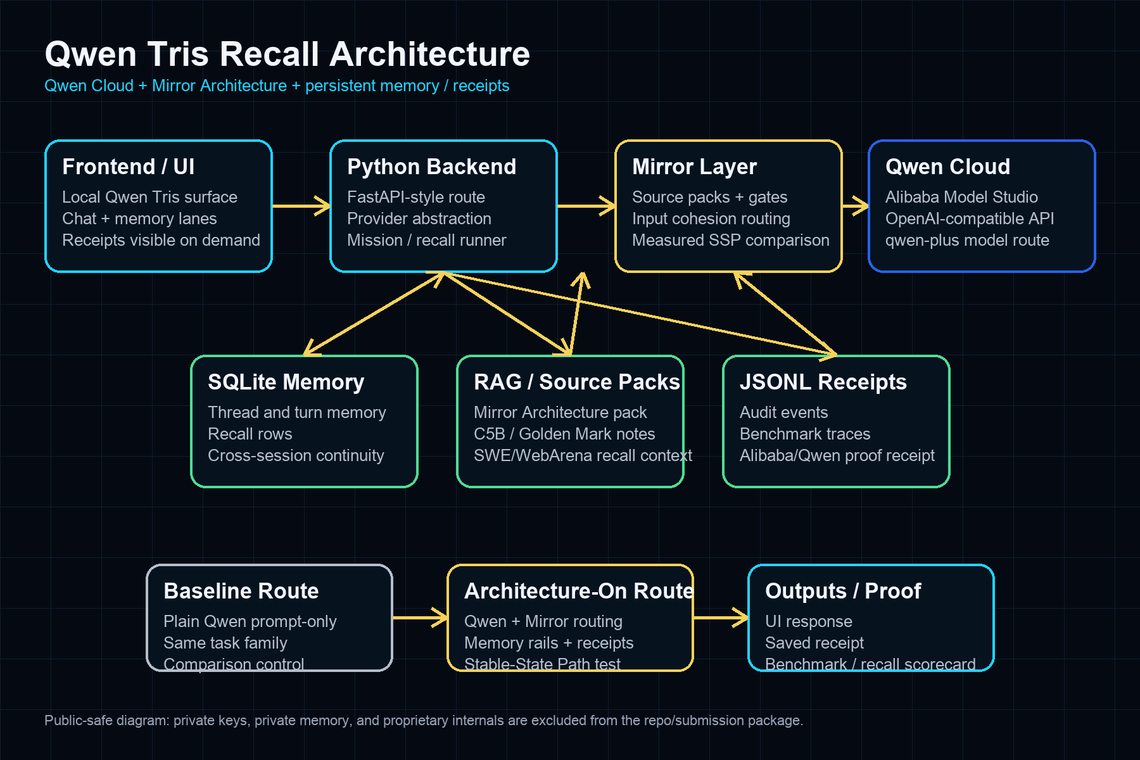
Stack flow
Interacts through the Qwen Tris Recall web surface or API endpoints.
Routes chat, memory reads, source retrieval, health checks, and receipts.
Preserves source context, corrections, receipts, and active gates so the architecture path can be measured across time.
Runs baseline/off first and architecture-on second with the same task family, scorer, and receipt gate.
Calls Alibaba Cloud Model Studio / Qwen Cloud through the OpenAI-compatible endpoint.
Alibaba / Qwen Cloud proof
This separate proof clip shows more than the account dashboard: it shows the public-safe Qwen API code, a live masked API receipt, and an actual Qwen Tris Recall architecture-on turn routed through `QwenCloudProvider` using `qwen-plus`. The turn retrieves seeded Tris memories, pulls Mirror Architecture/C5B evidence, and returns a Qwen Cloud response through the Tris AI Expert memory path.
Receipts
Condition B, Qwen plus Mirror Architecture measured SSP with memory/RAG rails, passed the hosted 500-turn memory slice.
Open 500-turn receiptC5B / Golden Mark showed the architecture-on route beating baseline Hermes across the same 100-turn task family: 13/13 metric means won, drift flags 37 -> 0, evidence failures 5 -> 0.
Open C5B support readTracks baseline Qwen, Qwen Tris architecture-on, LongBench-E, Qasper, support labels, and next gates.
Open verification ladderIncludes the lm-eval Qasper receipt and related result files for the public benchmark lane.
Open Qasper receiptThe repo now includes public-safe Qwen API code plus a masked proof clip showing Qwen Cloud running the Qwen Tris AI Expert route.
Open Alibaba/Qwen proof receiptMeasured State Path
SSP names the repeatable architecture trajectory that holds when the evidence spine, source pack, retrieval route, task gate, input cohesion, and model route stay aligned across a task family. V7 measures the visible behavior layer: recall, correction retention, drift reduction, source discipline, and cross-field synthesis. V8 is the internal-layer bridge when that instrumentation is available. C5B / Golden Mark is the current output-behavior support lane showing the architecture-on delta before the internal probe is closed.
The third comparison lane is the future checkpoint lane: Hugging Face / transformer adapter work, LoRA or PEFT-style tuning, and late-layer probes that test whether the SSP gain can be pushed further once real adapter receipts are attached.
Current receipt state: public repo, Qwen API proof code, hosted 500-turn memory receipt, LongBench/Qasper receipts, runnable local UI, and live RFL page are attached. The next public receipts are the Alibaba Cloud deployment recording and any accepted external evaluator or leaderboard row.
Submission status
Public repo, MIT license, run instructions, source code, architecture diagram, Qwen API proof code, tests, and public-safe receipts.
Attach the v02 Alibaba/Qwen proof clip to the submission, then mirror the same proof through a deployed Alibaba container if judges require a hosted backend URL.
The live Qwen Cloud operation demo is embedded first for the Devpost submission. The commercial/explainer remains on this page as the broader product story.
Post the build journey to Renaissance Field Lite channels for the optional public journey prize.
Commercial / explainer
This is the commercial/explainer already used on the website: Renaissance Field Lite's Mirror Architecture, measured SSP, input cohesion, Qwen Cloud routing, RAG memory, benchmark receipts, and AI Expert Partner product direction.